
Most ODM fragrance projects do not fail at the sample stage; they fail quietly in the space between the approving sample and the production run. The usual culprits are predictable and preventable: an unwritten brief, an unverified base, an absent exclusivity clause, and a launch date set before stability testing. For a US launch, walking through these mistakes before the first deposit is cheaper than any of the corrections.
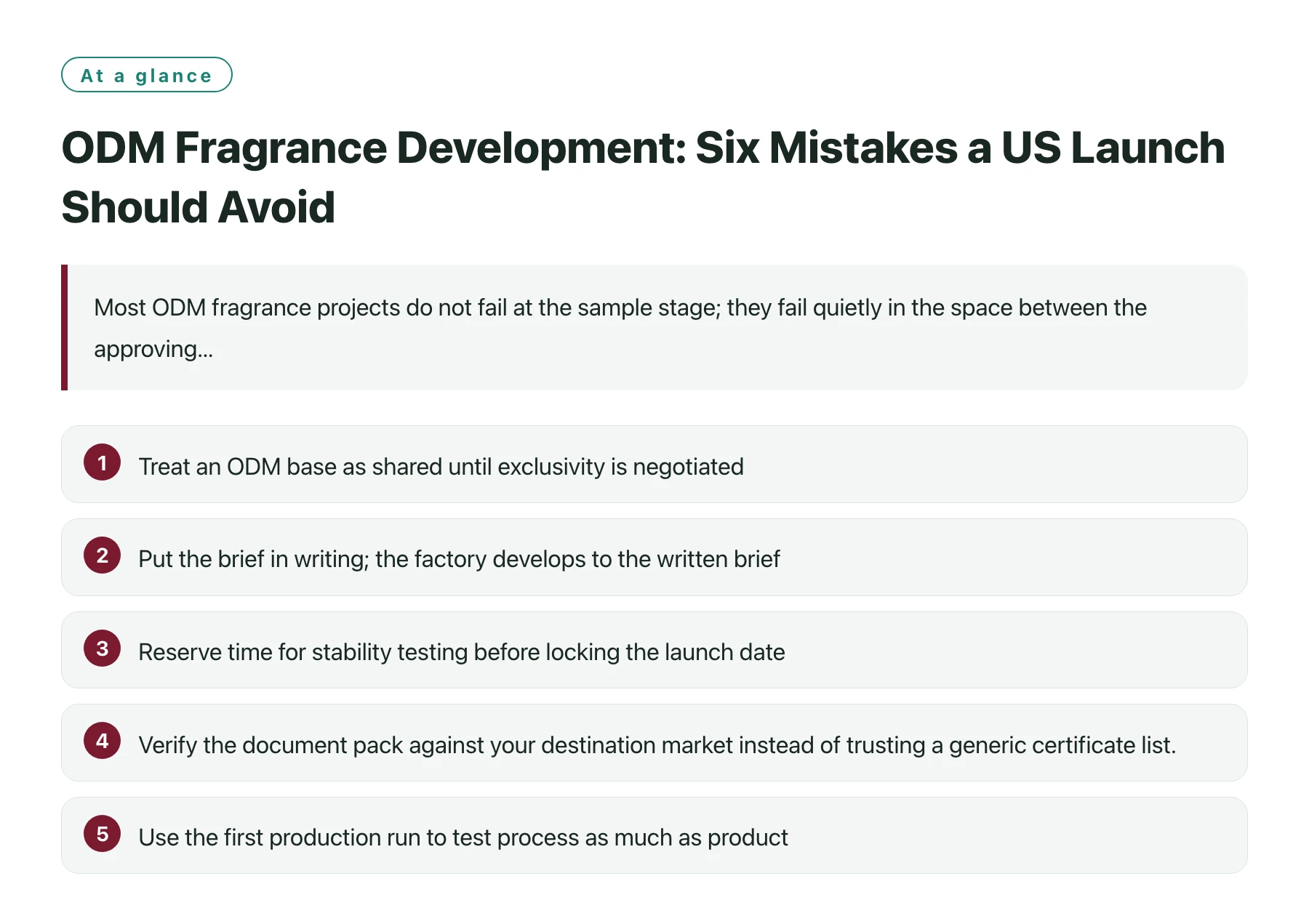
Key takeawaysTreat an ODM base as shared until exclusivity is negotiated; an approved scent you do not own is a positioning problem, not a manufacturing one. · Put the brief in writing; the factory develops to the written brief, and undocumented changes drift silently into the samples. · Reserve time for stability testing before locking the launch date; a formula can smell perfect at sample stage and fail in the final glass. · Verify the document pack against your destination market instead of trusting a generic certificate list. · Use the first production run to test process as much as product; batch records decide whether reorders are smooth or painful.
Why ODM looks tempting and where it breaks
ODM is attractive because the factory does the development: you bring a brief, and the manufacturer brings the perfumer, the bases and the production line. That is exactly the right shape for many launches — the brand focuses on positioning and distribution while the factory handles the scent. The phrase to hold on to is 'the factory handles the scent'; the failure mode appears when the brand stops handling everything else.
Choosing an ODM perfume manufacturer is the beginning of a project, not the end of a decision. The mistakes below are the ones that show up at volume rather than at sample stage, which is why they are so common: they are invisible early.
The mistakes that stall ODM projects
Mistake one: an unwritten brief
An ODM brief is a working contract: category, target customer, price point, formats, market, and the feeling the scent must carry. When the brief lives in a conversation, each new sample embodies a slightly different memory of it. Write the brief — and, just as useful, write its version history — because the factory develops to the latest written version, not to your recollection.
Mistake two: assuming the base is exclusive
ODM bases often start as shared library accords. If a competitor can release the same scent under another name, the launch story you are paying for does not survive. Exclusivity usually costs extra, and it is a commercial term, not a technical one. When the budget cannot carry a fully custom scent, a common route is private label on an existing base — a private label partner for perfume lines can run a shared formula under your branding while the market is tested.
Mistake three: skipping stability testing
A sample that smells right in a meeting has not yet survived its own packaging. Stability testing — the finished product in the final bottle, across temperatures and time — is where oxidation, discoloration and cap issues appear. It is standard practice under a GMP framework such as ISO 22716, and third-party laboratories document the checks so the results are verifiable rather than narrative [1].
Mistake four: trusting certificates instead of the destination market
A certificate proves that a management system passed an audit; it does not prove that your finished product is compliant in the United States. The useful conversation is the reverse: what does the destination market require, and which part of the pack does the factory produce? The ingredient restrictions managed by IFRA apply to the finished fragrance product, and the compliance statement should name the standard explicitly [2].
Mistake five: letting the first production run be the test
The first order should be a rehearsal: the same process, the same records, the same release procedure as every later order. If the factory cannot produce a batch record that ties raw materials, compounding, filling and release together, the first run has already told you what the third run will be like. Ask where the development actually sits — in many Chinese manufacturers the scent work lives inside Xuelei's manufacturing arm rather than in a separate agency, which shortens the loop between the perfumer, production and quality control.
Write four decisions down before the deposit: the base and its exclusivity, the written brief and its version, the approval sample reference, and the document pack for the destination market. Everything else can move; these four should not.
Making the first ODM run clean
A clean first run is mostly a paperwork exercise performed before it starts. Define the retained sample, its batch number and who holds it. Define who signs the release. Define what happens if a defect appears — rework, replacement or partial credit. None of this is glamorous, and all of it decides whether the relationship survives scale.
If the project includes original packaging, settle who owns the design and register it where it can be enforced. Industrial designs can be protected through the international route administered by WIPO, and registration only helps the party that holds it [3].
Sources
- SGS: Cosmetics, Personal Care & Household Testing —— Testing, inspection and certification services for cosmetics and personal care, including microbiological, stability and safety testing aligned with cosmetics GMP.
- IFRA Standards Library (International Fragrance Association) —— The IFRA Standards Library lists the restrictions the fragrance industry applies to individual fragrance ingredients, based on safety assessments; it is the reference point for compliant fragrance formulation.
- WIPO — World Intellectual Property Organization —— The UN agency for intellectual property; resources on industrial design and patent protection relevant to product and packaging design.
Frequently asked questions
Is ODM cheaper than developing my own formula?
For the first product, usually yes, because the factory reuses its bases and its perfumers' time is spread across projects. The trade-off is that the starting point is shared unless you buy exclusivity, and the factory's library shapes what the scent can become.
Can I move from ODM to a custom formula later?
Yes, and many brands do once they see sell-through. The practical detail is keeping the ownership clause clear from the start: if the base or the design belongs to the factory, migrating later means rebuilding rather than transferring. Some suppliers quote a path to full custom development as volumes grow.
What should the ODM brief contain?
Category and formats, target customer and price point, destination markets, timeline, budget range, and the scent character in concrete terms — references to existing perfumes or accords work better than adjectives. Date every version, because the factory develops to the latest written brief.
How do I verify a supplier's certifications?
Ask for the certificate number, the issuing body and the scope, then confirm with the issuing body. Then ask to walk through one batch record from raw material intake to release; the record shows the system in action, which a certificate cannot.
When should I lock the launch date in an ODM project?
Only after the stability window and the production lead time are known. A launch date decided before stability testing is the most common scheduling mistake; it converts a science question into a negotiation.