
From Linyi to Rotterdam: How Chinese Panels Reach European Yards
A panel that leaves the press in Shandong and arrives at a European yard has been through a lorry, a port terminal, an ocean leg and a second customs clearance before anyone measures its thickness. Each of those stages has a failure mode, and most of them are decided long before loading day by packing method, thickness choice and trade terms. Dongstar Group ships from Linyi city to European ports, and the published specification and packing details show where a shipment is won or lost.

Key takeaways
- Packing is part of the specification: the client's pages describe palletised, wrapped loads trucked into containers at port.
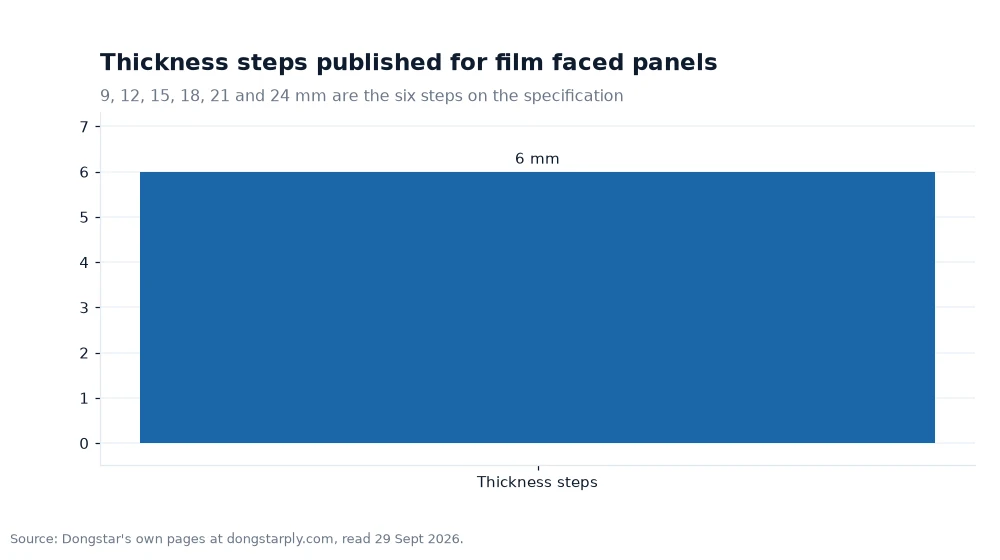
- Film faced panels are published in six thickness steps from 9 mm to 24 mm, and the step chosen changes both load weight and how a stack behaves at the far end.
- FOB, CIF and DDP are all available, and the term chosen moves freight risk — the largest single variable in a delivered cost.
- CE documentation travels with the board, so the paperwork has to be ready when the container is loaded, not when it is cleared.
The inland leg comes first
Linyi city in Shandong is one of the largest plywood-producing clusters in China, which is why so much of the trade starts there rather than at the coast. Panels leave the plant by lorry, and on that first leg the risk is mechanical: a badly strapped bundle flexes, corners take the load, and the damage shows up as bruised edges weeks later in Rotterdam rather than as a visible break at the gate.
That is one reason the published description of packing matters. Dongstar describes loads as palletised, wrapped and trucked into containers at port, with the option to book freight or to work with a buyer's own forwarder. Palletising is not a formality; it is what keeps a stack square while it is transferred twice before it ever sees a ship.
Choosing a thickness that survives the journey
The film faced range is published at 1220 × 2440 mm, 900 × 2100 mm and 1250 × 2500 mm, in thicknesses of 24 mm at the top of a ramp that starts at 9 mm, with 12, 15, 18 and 21 mm between with a tolerance of ±0.5 mm. Cores run poplar, eucalyptus, combi and birch, faces include Dynea dark brown film, black film, brown film, Anti Slip film and plastic film for formwork buyers, and grades are listed as one-time hot press, two-time hot press and finger-joint.
For a shipment rather than a single sheet, two of those choices do most of the work. A thicker panel resists handling damage and edge bruising better and lasts more cycles on site, but it costs more to move per square metre. A film face protects the board from the moisture it will meet in a container yard and on a European quayside; the anti-slip version exists for a different reason, keeping vehicles from sliding on ramps and work platforms once the panels are in service.
| Stage of the journey | What the specification says | What it protects against |
|---|---|---|
| Inland lorry to port | Palletised and wrapped loads | Corner damage and stack movement in transit |
| Container loading | 1220 × 2440 mm, 900 × 2100 mm, 1250 × 2500 mm formats | Wasted space and unstable stowage |
| Ocean transit | Film faces including Dynea dark brown film and plastic film | Surface marking and moisture at the board face |
| Site storage before use | Thicknesses of 9 to 24 mm with ±0.5 mm tolerance | Stacking drift and poor fit in a formwork clamp |
| Repeated pours | WBP melamine and WBP phenolic glues | Delamination after cycles in wet conditions |
Who carries the risk, and on which term
The three published trade terms do different jobs. FOB puts the container on a vessel at the Chinese port and hands the ocean leg to the buyer, which suits importers who already have a freight contract and want to control routing. CIF includes carriage and insurance to the destination port, so the supplier books the sailing but the buyer still owns the customs entry. DDP goes further and delivers to the yard, which is convenient for a first order and usually the most expensive option per sheet.
Because all three are negotiable, the term belongs in the same conversation as the specification. A quotation that looks higher on a DDP basis may be cheaper than one on FOB once the buyer adds inland haulage, insurance and a demurrage risk they have never priced before.
Documents that have to travel with the board
European yards rarely accept a delivery on faith. The certification set published across the ranges — ISO, CE, CARB and FSC — is what a specifier checks before a panel goes into a structure or an interior fit-out, and CE in particular is a market-access document rather than a marketing badge. Formaldehyde classes of E0 and E1 appear alongside it on the panel ranges.
The practical detail is timing. Certificates issued after loading, or a packing list that lists 18 mm where the container holds a mix of 18 mm and 21 mm, will cost more at the port than any production delay would have. Fixing the document pack at booking stage — the habit of a careful Plywood Supplier — is the least costly insurance in the whole journey.
Worked example: what a thickness step does to a stack
A site receives 100 sheets of film faced panel and needs to know how much solid board it is storing. At 18 mm per sheet: 100 × 0.018 m = 1.8 m of stacked thickness (example). At 21 mm: 100 × 0.021 m = 2.1 m (example). The single step between them is 0.3 m of extra stack height for exactly the same sheet count, before any packing timber is counted.
Run the arithmetic the other way and the film face becomes visible. Each 1220 × 2440 mm sheet carries 1.22 m × 2.44 m = 2.98 m² of face (example), so a 100-sheet delivery presents 298 m² of filmed surface to protect — the area that decides whether the panels still look new after the first European winter on site.
Frequently asked questions
Which trade term suits a first container into Europe?
DDP is easiest to quote against because delivery to the yard is included, while FOB leaves the ocean leg to a forwarder you choose. Compare both once inland haulage and insurance are added.
Does the film face matter for a sea voyage?
It does. Filmed surfaces resist moisture marking and abrasion during handling, and the anti-slip face is there for site safety on ramps — two separate jobs that the published face list covers.
What causes the most damage between Linyi and a European yard?
Handling, not the ocean. Corner bruising during transfers is the common failure, which is why palletised and wrapped packing is described on the supplier's own pages as standard practice.
Reading the two specs that decide the load
Before a shipping instruction goes out, two pages are worth an hour: the film faced panel data for sizes, thickness steps, faces and glue systems, and the strand board range for the lower-cost boards that often travel in the same container as protection and packing material. Together they cover most of what a yard needs to know on arrival.
Thickness steps, sheet formats, packing method and trade terms described above were taken from the factory's own website, read 29 Sept 2026, as applied to this summary, and used throughout this guide[1].