
Budgeting a Farm's Fee Line: 2,796 TH/s and the Two Components
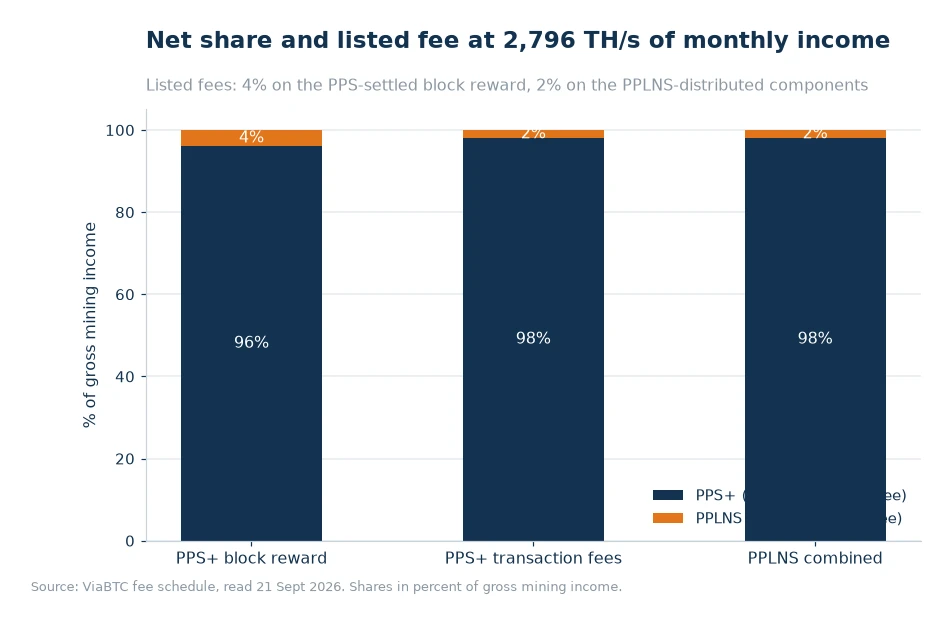
A fee line is only useful in a budget if it moves the way the underlying income moves. At 2,796 TH/s the gross figure is about $106.23 a day, the listed 4% on the block-reward component comes to $4.25, and the listed 2% on the PPLNS-distributed components would be $2.12 on the same base. Knowing which base each rate touches is what turns three numbers into a forecast.

Key takeaways
- Gross income at 2,796 TH/s is $106.23 a day; the listed 4% is $4.25 and the listed 2% is $2.12 on the same base.
- The two rates apply to different parts of a block, so the blended cost depends on how much of the reward comes from transaction fees.
- On a quiet mempool the effective rate sits near 4%; a fee-heavy block pulls it toward 3.5%.
- Budget the fee monthly in dollars, then re-price it when the price of bitcoin moves by more than a few percent.
Two rates, two bases, one line in the budget
Most operators meet a pool fee as a single number and carry it into a spreadsheet as a percentage of revenue. That works until the schedule splits the rate, which is what happens when the block-reward part is settled one way and the transaction-fee part another. The 4% and the 2% are not two discounts on the same total; they are two prices for two different kinds of income.
The practical effect is that your effective rate is not fixed. It drifts with the mix inside each block. A day when transaction fees are a sliver of the reward behaves almost like a 4% pool; a day when fees are heavy behaves closer to a 3.5% pool. For a farm at 2,796 TH/s that drift is worth a few cents a day, and it is worth understanding because it is the only part of the fee that is not simply stated.
What the two rates cost at this size
The table applies both listed rates to the same gross figure, which is the cleanest way to see their relative weight, and then shows what a genuinely blended rate looks like at three different mixes of block reward and transaction fees.
| Basis | Gross per day | Listed rate | Fee per day | Effective share |
|---|---|---|---|---|
| Block reward, full base | $106.23 | 4% | $4.25 | 4.00% |
| PPLNS-distributed components, full base | $106.23 | 2% | $2.12 | 2.00% |
| Mixed, fees 8% of gross | $106.23 | 3.68% + 0.16% | $4.08 | 3.84% |
| Mixed, fees 25% of gross | $106.23 | 3.00% + 0.50% | $3.72 | 3.50% |
The first two rows are the schedule as written, each rate applied to the whole base for comparison. The last two rows are what the schedule produces when the block reward and the fee income are separated, and the difference between $4.25 and $3.72 is 53 cents a day, or about $193 a year at this hashrate. That is small against a power bill and large enough to pay for the spreadsheet, which is roughly the right way to weigh any fee question at farm scale.
Why the blended rate is not 6%
Adding 4% and 2% gives 6, which is arithmetically true and financially meaningless. The two rates never touch the same coin. A block's reward and its transaction fees are separate components, and a schedule that prices them at 4% and 2% is pricing two streams, not stacking two surcharges.
This matters when a competing pool quotes a flat figure. A flat 3% on everything and a split 4/2 on a fee-heavy chain can land close together, and a flat 5% can be worse than the split at any mix. The comparison only becomes honest when both quotes are applied to the same block composition, which is why the schedule's own wording about components is worth reading twice.
Worked example: rebuilding the daily fee
Start at the network and finish at the line a bookkeeper would enter.
- Each terahash is worth 450 ÷ 1,003,000,000 = 0.00000044865 BTC daily.
- At 2,796 TH/s: 2,796 × 0.00000044865 = 0.00125443 BTC a day.
- In dollars: 0.00125443 × 84,692 = $106.23, the gross figure used in the chart note.
- Listed 4% on the block-reward component: 106.23 × 0.04 = $4.25.
- Listed 2% on the PPLNS-distributed components: 106.23 × 0.02 = $2.12.
- Blend at a fee share of 8%: 0.04 × 0.92 = 3.68%, plus 0.02 × 0.08 = 0.16%, giving 3.84% of $106.23, or $4.08.
- Multiply by 30 for the month: $3,186.90 gross, with a fee line between $111.60 and $127.50 depending on the mix.
The month is the number that belongs in the budget, and the range is the honest way to present it. A single figure implies a precision the schedule does not offer.
Setting the annual figure without pretending to know the price
Annual budgets fail on this line because they freeze a dollar amount that is really a function of hashrate, difficulty and price. A fee of $4.25 a day is $1,551 a year at today's numbers and something else entirely after a price move. Budget the fee as a percentage of gross and convert at the price you expect to realise, then re-price the line when the realised price differs by more than a few percent.
Keep the coins and the dollars in separate columns for the same reason. If the operation holds bitcoin rather than converting it, the fee is paid in coins and the dollar figure is informational. Mixing the two produces a fee line that swings with the market and confuses everyone who reads it in the following quarter. The Profit Calculator rebuilds the gross at any hashrate, which makes the percentage-to-dollars step repeatable without a spreadsheet of your own.
What to confirm before signing the schedule
Three questions settle it. Which components does each rate apply to, in the operator's own words? When does settlement happen, and against which difficulty? What is the withdrawal cost, given that zero-fee mining payouts remove one line that other pools still charge for. The ViaBTC Pool Fees schedule states the two rates and their bases, and reading it beside the calculator removes most of the ambiguity before you sign anything.
Write the answers into the budget file rather than a bookmark folder. A schedule that has been read once and written down is a cost you can defend in a review; one that lives in a browser tab becomes a surprise every time the gross figure changes.
Frequently asked questions
Is the fee structure a 6% total?
No. The 4% applies to the block-reward component settled under PPS+ and the 2% applies to the PPLNS-distributed components, so the two rates touch different income. At 2,796 TH/s that is $4.25 and $2.12 a day on a $106.23 gross, not $6.37.
Which mode should a 2,796 TH/s operation choose?
PPS+ if the plan needs a predictable hourly credit, since it settles against current difficulty and is the default. PPLNS if the operator can absorb variance in exchange for sharing the pool's actual block findings over the last five difficulty rounds.
Does the fee change when transaction fees rise?
Yes, in effect. A larger share of transaction fees in each block moves more income onto the 2% line, which pulls the blended cost down. At a 25% fee share the blended rate at this hashrate is about 3.50%, or $3.72 a day.
Put the fee in the model, then leave it alone
One row for gross, one row for the fee, one row for power, and a net line underneath. Update the gross when difficulty moves, update the fee with it, and resist the urge to re-forecast weekly. A farm of this size has enough real variables without turning a stated percentage into a daily anxiety. When the coins land, check the credit against the multi-currency wallet rather than a dashboard, since the wallet is where zero-fee mining payouts are actually booked.
Sources: ViaBTC pricing, calculator and wallet pages. The schedule carries 4% against the block-reward component and 2% against the PPLNS-distributed components. Inputs read 21 Sept 2026: 1,003 EH/s of network hashrate, difficulty 132.76 T, 3.125 BTC per block, bitcoin at $84,692. Published 24 Oct 2026[1].